
Stop Letting Website Issues
Cost You Leads, Trust, and Time.
Your website doesn’t need to be perfect. But it shouldn’t be slowing your business down either.
Use our free 90-Day Website Improvement Plan to identify website issues affecting lead generation, user experience, and team efficiency.
Your Website Might Not Need an Entire Redesign
We’re not another agency here to tell you that your website needs a full redesign or rebuild.
For many businesses, the bigger issue is that the current website hasn’t been maintained or improved in a structured way. That could mean your content is outdated, forms have stopped working, and small UX issues are turning into missed opportunities.
Small issues can build up quickly, especially when no one has time to stop and sort out what actually matters.
Get a Clearer Plan for What to Fix First
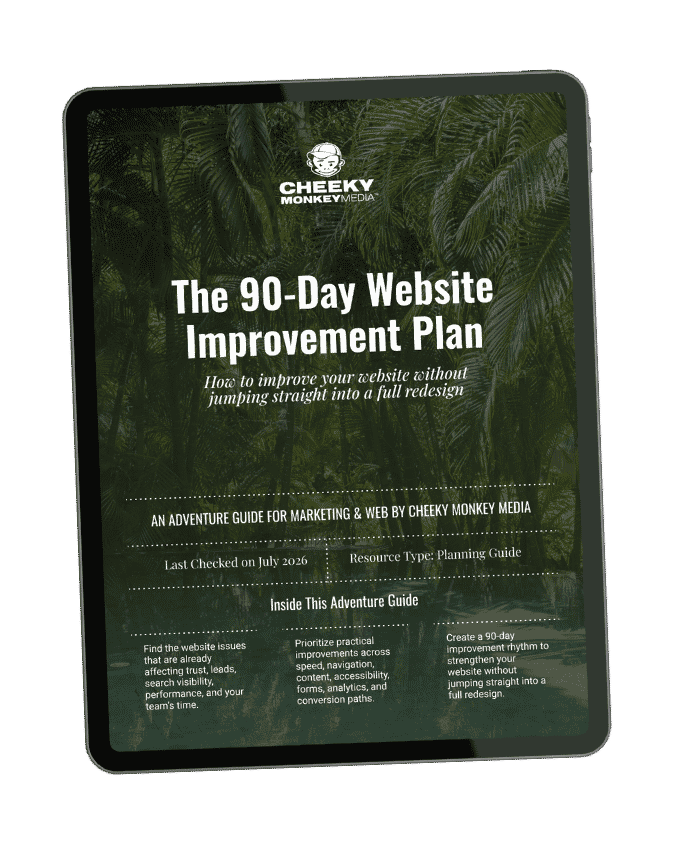
The 90-Day Website Improvement Plan helps you review the parts of your website that most often affect performance, trust, and conversions.
Inside the guide, you’ll learn how to:
- Identify website issues affecting leads, trust, search visibility, performance, accessibility, and team time
- Review key areas like content, navigation, forms, page speed, analytics, accessibility, and conversion paths
- Separate quick wins from bigger website improvements
- Prioritize updates your team can realistically tackle over the next 90 days
- Make meaningful website progress without jumping straight into a full redesign
For Teams That Need Their Website to Do More
This guide is for teams that know their website is technically working… but not working hard enough.
You might be dealing with:
- A website that gets traffic, but not enough qualified inquiries
- Forms, CTAs, or contact paths that create friction instead of momentum
- Messaging that feels too vague, outdated, or hard for prospects to understand quickly
- Service pages that no longer reflect what you actually offer
- An internal team that keeps patching pages, chasing updates, or working around the website
- Small UX, content, accessibility, or performance issues that keep getting pushed
- A growing sense that the site needs attention, but no clear agreement on whether that means a refresh, redesign, rebuild, or better ongoing support
Need Help Turning This Plan Into Action?
Spotting the website issues is one thing. Finding the time, technical support, and clear plan to fix them is another.
Cheeky Monkey Media helps high-trust businesses improve, maintain, and evolve their websites through practical support and technical expertise without overwhelming internal teams.
That can include website assessments, support sprints, UX improvements, accessibility fixes, content updates, landing pages, performance improvements, QA, reporting, and long-term website care.
Whatever your website needs, we can help you sort through what matters most and keep the work moving.
We can support things like:
- Website assessments and improvement roadmaps
- Support sprints and ongoing maintenance
- UX, accessibility, and performance fixes
- Content updates, landing pages, and better conversion paths
- QA, reporting, measurement, and long-term website care
So your website does more than stay online. It becomes easier to trust, easier to use, and easier for your team to manage.
TESTIMONIALS
What Our Clients Say
Cheeky Monkey Media is a really great group to work with. We’ve exchanged calls and emails and because of the time difference, they’ve gotten up early in the morning to accommodate me. Even if I send an urgent email on the weekend, I’ll get a response, which is fantastic. I’ve never worked with another company like this before.
We were really impressed with their knowledge of Drupal. It is comforting to know that when you bring a project to Cheeky Monkey Media, they’re already very knowledgeable. If they’re not familiar with the issue, they’ll do research about it. You don’t feel like there is a better solution. I can trust what they’re telling me. I know that Cheeky Monkey Media has gained the respect of even our internal IT team.
We have had a huge increase in traffic. We’re seeing almost 20,000 extra users on average per month ever since we moved from a Microsoft-based environment to a UNIX-based environment.
The Cheeky Monkey team was always responsive in all our communications – it’s a pleasure to know they are just as quick to pick up the phone versus hiding behind emails. They dove into the development of the React app and our high expectations, and not only did they technically pull it off they kept the project within budget.
Gene Bernier
Recently, we had a sudden need for a WordPress site that we were trying to migrate. After about a week, our team couldn’t get it done. I reached out to Cheeky Monkey Media at the last minute. They were able to get someone to look at it within the hour, and basically had it up and running in 2 hours.
The way Cheeky Monkey Media was able to brand our company was great… Because they broke this project up into pieces, we didn’t have to go back and change anything. There are no surprises during the project.
Frequently Asked Questions
Is this guide only for teams planning a full website redesign?
Nope. In fact, it’s partly for teams who are trying to avoid jumping into a full redesign too quickly.
Sometimes a website needs a full rethink. But, more often, companies actually need focused improvements, better maintenance, clearer content, or a healthier support rhythm. This guide helps you figure out what makes the most sense before committing to a bigger project.
Who is this guide best for?
It’s best for B2B, professional services, and purpose-driven teams that need their website to do more than just sit there looking decent.
Think: building trust faster, making your services easier to understand, helping the right people get in touch, and taking some pressure off your internal team.
Do we need technical experience to use it?
No. The guide is built for marketing, communications, leadership, and operations teams — not just developers.
You don’t need to know how to fix every issue yourself. The goal is to help your team spot what’s getting in the way, prioritize what matters most, and have clearer conversations about next steps.