
If you explored Drupal a few years ago, you probably came away thinking, “too complicated.” That’s still a common perception. But Drupal CMS has changed more in the past year than it did in the five years before, and 2026 has been a big year for Drupal news and updates.
Your team can now build pages with drag and drop. New sites can launch from ready-made templates. Optional AI tools help with the heavy lifting. And the engine underneath just got its biggest speed boost in a decade.
In this post, we’ll walk through what’s changed, why each update matters for your organization, and what’s coming next.
New to Drupal? Start with our guide that focuses on the most essential question: What Is Drupal?. Then come back here for the latest news.
Why Drupal Has a Reputation for Being Hard
Let’s be honest: Drupal earned its reputation. For years, developers built it for developers. It was powerful, secure, and endlessly flexible, but everyday tasks often felt like more work than they should.
Building a landing page meant filling out back-end forms, saving, previewing, and going back to tweak. Many marketing teams ended up waiting on a developer for changes that should have taken five minutes.
Over time, that started to change. Newer versions of Drupal brought a cleaner admin dashboard, a better text editor, drag-and-drop layouts, and an easier way to manage images and media. Bit by bit, Drupal got friendlier.
The problem is that reputations stick. Plenty of people still remember the old Drupal, and the “too complicated” label still follows it around. The Drupal community heard that feedback loud and clear, and instead of brushing it off, they made ease of use a top priority.
So if you still think of Drupal as the hard one, you might be surprised by what it looks like today. Here’s what’s changed.
Drupal News: What's Changed in 2026
Drupal CMS 2.0: Drupal, Ready to Go
First, a quick bit of background, because there are now two versions of Drupal you’ll hear about.
| Drupal core | Drupal CMS |
|---|---|
| The engine every Drupal website runs on. It's the flexible, secure foundation developers have built on for years. On its own, though, core is a blank slate. Your team or agency has to choose and set up everything else. | Built on top of Drupal core. It bundles core with the add-ons and settings most organizations need anyway, so you start with a working site instead of an empty toolbox. It's the same Drupal underneath and works with the same modules, so you're never boxed in. |
The first version, Drupal CMS 1.0, launched in January 2025. It focused on the basics: a simpler installer with smart defaults, a project browser for finding add-ons, automatic security updates, built-in SEO and accessibility tools, and a cleaner admin dashboard.
Drupal CMS 2.0 launched on January 28, 2026, and it’s the bigger leap. It shifted the focus from setup to everyday editing, adding Canvas, site templates, and optional AI tools (more on each below), plus ready-made integrations with tools like Mailchimp and Google Analytics.
Why This Matters: You no longer have to choose between power and ease of use. Drupal CMS gives your team a friendlier starting point, while your developers still have full access to everything Drupal core can do. And because it’s all one platform, you can start simple and grow without switching systems later.
Drupal Canvas: Drag-and-Drop Page Building
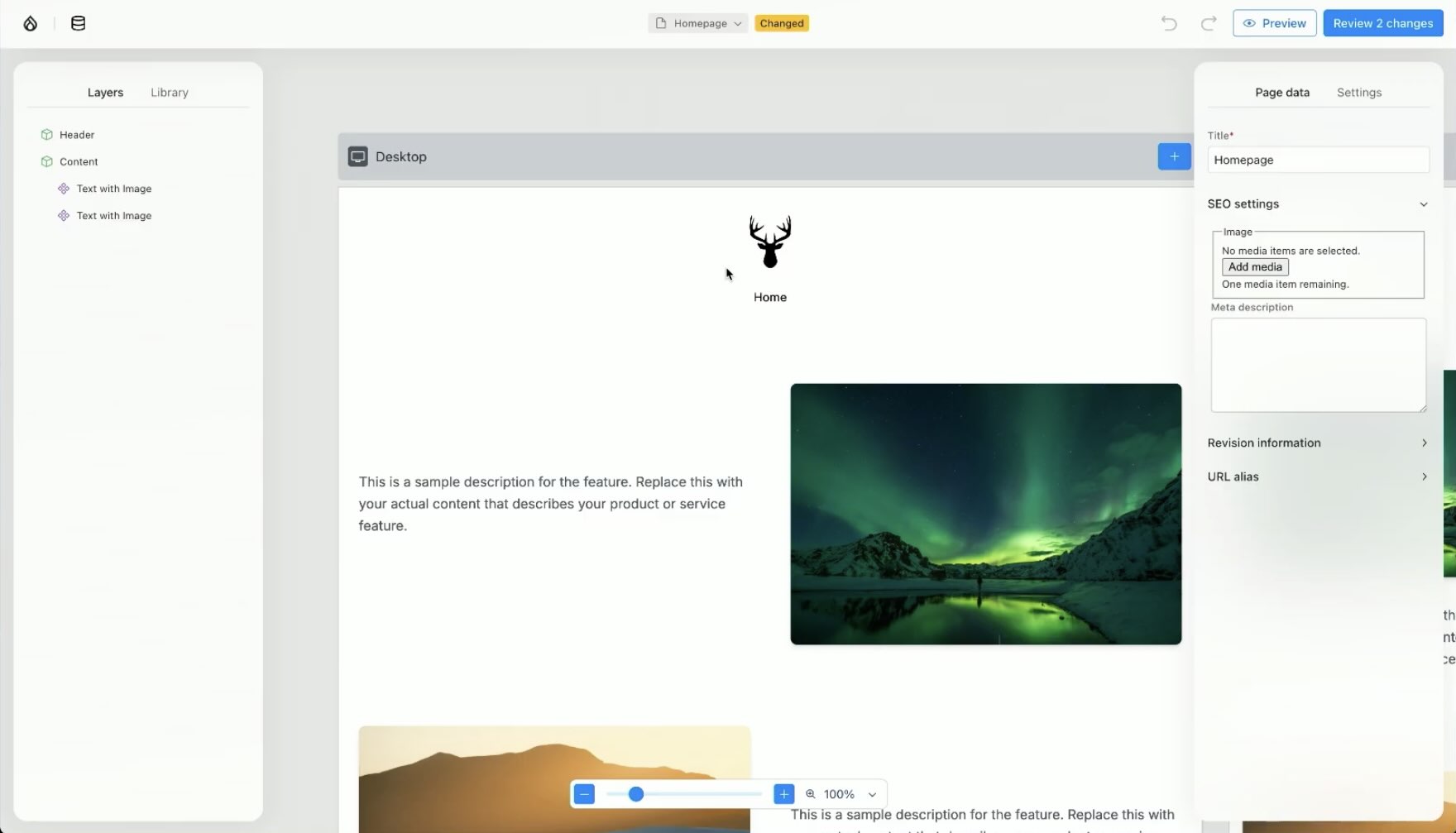
The biggest change is Drupal Canvas, a visual page builder that’s now the default editing experience in Drupal CMS. Instead of filling out back-end forms, your team builds your website right on the page, with a live preview as they go.
Canvas works with reusable components, like hero banners, cards, and call-to-action blocks. Your developers set those components up once, on brand, and your editors mix and match them to build new pages.
Why This Matters: Using Drupal today means you’re not tied to a Drupal developer or agency for every little change. It’s a complete shift from the old experience.
Now, your marketing team can launch a campaign page without opening a support ticket. Your developers (or agency partner) get to focus on bigger projects instead of small layout changes.
Plus, editors build with approved components, which means your site stays on brand and accessible, no matter who publishes.
Site Templates
Drupal CMS 2.0 also introduced site templates. These are near-complete starting points that come with a design, content types, layouts, and sample content already in place.
The first template, Byte, is built for tech and software marketing sites, with more planned for specific types of organizations.
Think of templates as the next step beyond traditional Drupal themes. A theme controls how your site looks, while a template also provides a working site structure.
Why This Matters: With the site template addition, your team spends less time on setup, meaning a faster launch and a smaller upfront budget. Your Drupal development team can spend its time on the features that make your site unique, instead of rebuilding the basics every organization needs.
Optional AI Tools, Built Right In
Drupal CMS 2.0 brings AI help right into the admin area. For example, your team can describe a page in plain language and have Canvas generate a draft using your site’s existing components.
The key word here is optional. You decide whether to turn the AI features on at all.
Why This Matters: We all know that AI is powerful; however, we need to use it with caution. In this Drupal CMS update, AI can help your team get a first draft up faster. We recommend then polishing it by hand.
Because it builds with your own components, the result stays on brand. And for organizations with strict privacy or procurement rules, keeping AI optional lets you adopt it at your own pace.
Drupal 11.3: The Biggest Speed Boost in a Decade
Under the hood, Drupal CMS 2.0 runs on Drupal core 11.3, which brought Drupal’s biggest performance improvement in about ten years. According to the Drupal Association, sites can now handle 26 to 33 percent more requests on the same setup.
Drupal 11.4 followed in late June 2026, continuing Drupal’s steady, predictable release cycle.
Why This Matters: Faster sites keep visitors around longer, and page speed is one of the things Google looks at when ranking pages. It also helps with Drupal hosting costs.
Handling more traffic on the same server means you can ride out a big announcement or enrollment season without paying for extra capacity.
Drupal 12 Arrives in December 2026
The next major version, Drupal 12, is scheduled for release the week of December 7, 2026. Like recent major versions, it’s an upgrade, not a rebuild. Drupal 12 mainly removes older code phased out in Drupal 11, keeping the platform lean and modern.
Drupal 11 isn’t going anywhere yet, either. It’s expected to be supported until mid to late 2028.
Why This Matters: You get a predictable roadmap you can plan and budget around. If your site is on the latest version of Drupal 11, you’re already on the path to Drupal 12, with no big surprises.
Drupal 10 Reaches End of Life on December 9, 2026
This is the one date to circle on your calendar. Drupal 10 reaches end of life on December 9, 2026. After that, there will be no new Drupal 10 releases, including security fixes.
End of life doesn’t mean your site will suddenly break. But it does mean any new security issue found after that date won’t get fixed.
Why This Matters: If your site still runs on Drupal 10, now is the time to plan your Drupal migration to Drupal 11. Moving from 10 to 11 is much simpler than the big version jumps of the past, but it still needs careful testing, especially for custom code and add-on modules. Starting now gives you time to do it right instead of rushing in December.
If you’re still on Drupal 7, don’t worry you’re not alone, but it’s probably time to upgrade. It reached end of life in January 2025, so your site may become increasingly vulnerable, especially with the rise of AI and the current state of site security.

What Hasn't Changed (and Where a Drupal Team Still Helps)
Drupal’s core strengths are all still here. It’s still:
- Open source
- Has no licence fees
- Has a dedicated security team
- Handles multiple languages
- Allows for complex permissions
- Works effectively with large amounts of content
SEO in Drupal is still strong, too. You get control over page titles, meta descriptions, clean URLs, and site structure, which helps both Google and AI search tools understand your content.
What’s changed is who can do what. Canvas and templates make everyday editing much easier for your team. But setting up components, connecting your CRM or donation platform, building custom features, and managing upgrades still take experienced Drupal developers.
In our opinion, that’s the best of both worlds. Your team handles day-to-day publishing, while your Drupal partner handles the technical side. Ongoing website maintenance and support keep updates, security patches, and hosting running smoothly in the background, so no one is stuck waiting on anyone.
Is Drupal CMS the Right Choice for You in 2026?
Drupal CMS is a strong fit if your website is central to how you serve people, raise money, or win business. That’s especially true if you have lots of content, several editors or departments, more than one language, or strict security and accessibility requirements like AODA.
If you just need a simple site with a few pages and one person updating it, WordPress or a hosted website builder may get you there faster. We work with both, so we’re happy to help you figure out which one makes sense.
Our WordPress vs Drupal comparison is a good place to start.
Already on Drupal? The 2026 updates are a great reason to stay and invest in your existing site rather than starting over on a new platform.
Ready to Make the Most of Drupal CMS?
Drupal has always been powerful. But in the past, it’s also been complicated.
In 2026, Drupal CMS finally makes its powerful platform easier to use. With Canvas, templates, optional AI tools, faster performance, and a clear roadmap, it’s a stronger choice than ever for organizations that need a website they can grow with.
At Cheeky Monkey Media, Drupal is our specialty. We’ve been a Drupal development agency for over 18 years, helping universities, governments, nonprofits, and growing businesses build, migrate, and support Drupal websites that actually work for their teams.
Whether you’re planning your move off Drupal 10, wondering if Canvas could free up your marketing team, or just want a second opinion on your current site, we’re here to help. Start with a website audit, or get in touch with our team.
Frequently Asked Questions
What is Drupal CMS?
Drupal CMS is a ready-to-go version of Drupal built on top of Drupal core. It includes smart defaults, a visual page builder called Drupal Canvas, site templates, and optional AI tools, so organizations can launch and manage websites faster.
What's the difference between Drupal CMS and Drupal core?
Drupal core is the engine every Drupal website runs on. Drupal CMS bundles Drupal core with extra tools and settings that make it easier for non-developers to build and edit pages. Both are free and open source.
What's new in Drupal CMS 2.0?
Drupal CMS 2.0 launched on January 28, 2026. It made Drupal Canvas the default editor and added the first site template, optional AI tools, and new integrations. It runs on Drupal core 11.3, which brought major speed improvements.
When is Drupal 12 coming out?
Drupal 12 is scheduled for release the week of December 7, 2026.
When does Drupal 10 reach end of life?
Drupal 10 reaches end of life on December 9, 2026. After that, it won’t get security updates, so sites still on Drupal 10 should plan an upgrade to Drupal 11.
Do I need a Drupal developer to use Drupal CMS?
For everyday editing, no. Canvas lets your team build and update pages without touching code. For setup, custom features, integrations, and upgrades, working with an experienced Drupal development company will save you time and help you avoid costly mistakes.