
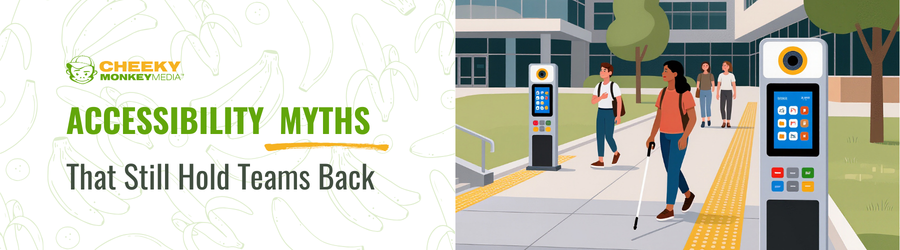
Accessibility is often talked about as a requirement or a future improvement. Sometimes it is treated as a legal concern, and other times, it is framed as something that only applies to a small group of users.
In reality, accessibility is about how real people experience your website every day. And most of the hesitation we see around accessibility comes from a handful of persistent myths. Let’s clear a few of them up.
Myth 1: People with disabilities do not use our website
They do. Every day.
Disability is far more common than most teams realize, and many people never disclose their needs. Some users rely on screen readers or voice control while others navigate using a keyboard, need captions, or benefit from clear structure and predictable layouts.
If your website is public, people with disabilities are already using it. The real question is whether your site makes that experience smooth or frustrating.
Myth 2: Accessibility will ruin our design
Good accessibility does not ruin design. It strengthens it.
Clear contrast, readable typography, consistent navigation, and thoughtful spacing are all accessibility best practices. They also happen to be fundamentals of good user experience. When accessibility is considered early, it rarely feels like a compromise and it saves you money in the long run.
Accessible design is not about removing creativity. It is about designing with intention so no one is excluded by default.
Myth 3: Accessibility is only about screen readers
Screen readers are important, but accessibility is much broader than that.
Accessibility includes keyboard navigation, captions and transcripts, readable content, clear focus states, and interactions that work across devices and assistive technologies. It also supports people with temporary or situational limitations, such as an injury, bright sunlight, poor connectivity, or a noisy environment.
When accessibility is done well, many users benefit without ever realizing why the experience feels easier.
Myth 4: We can fix accessibility after launch
This is one of the most costly assumptions teams make.
Addressing accessibility after a site is built often takes more time and budget than building it in from the start. Retrofitting can mean reworking layouts, navigation, or content that could have been addressed earlier with less effort.
Accessibility works best when it is treated as an ongoing practice, not a one-time fix at the end of a project.
Myth 5: Accessibility only matters if you are worried about lawsuits
Legal compliance is part of the conversation, but it should not be the only motivator.
Accessibility is closely tied to trust, inclusion, and credibility. For nonprofits, higher education, and public-facing organizations, it reflects your values and your commitment to serving your entire audience.
A more accessible website is often more usable, more resilient, and better aligned with long-term goals.
The Bigger Picture
Accessibility is not a trend or a box to check. It is part of building digital spaces that work for real people in real situations.
You do not need to do everything at once. Small, thoughtful improvements over time make a meaningful difference. When accessibility becomes part of regular maintenance and decision-making, it feels far more achievable and far less overwhelming.
A Gentle Next Step
Accessibility does not have to be all or nothing.
If your team is unsure where to start, a small audit, a few prioritized updates, or a conversation about what is realistic right now can go a long way. Accessibility is most effective when it is part of ongoing care, not a last-minute scramble.
If you want a second set of eyes or help turning good intentions into practical next steps, our team is always happy to help you figure out what makes sense for your site.